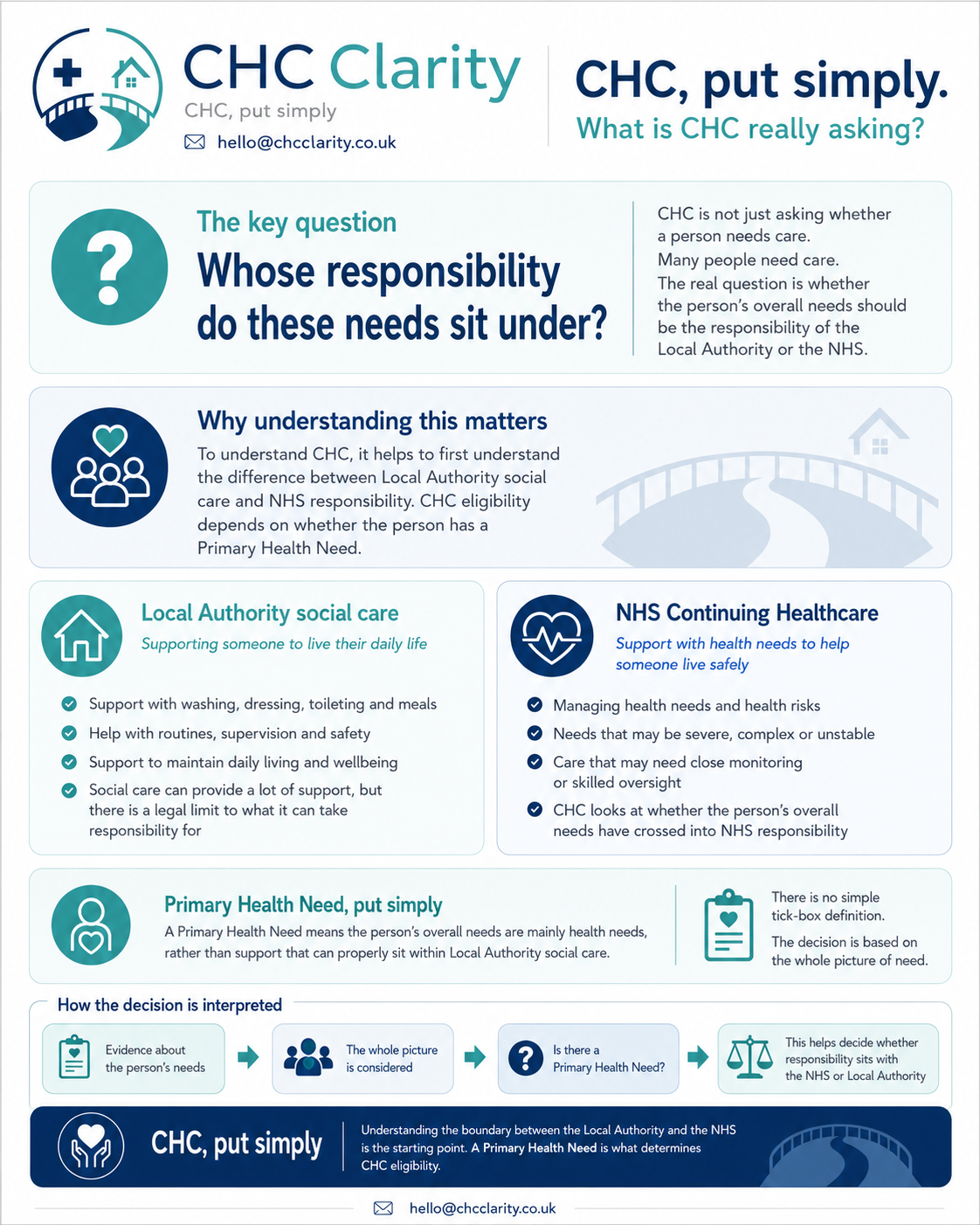
What is CHC really asking?
NHS Continuing Healthcare can feel confusing because families are often given forms and terminology before the basic question has been explained. Before looking at the Checklist, DST or decision, it helps to understand the boundary between Local Authority social care and NHS responsibility.
Whose responsibility do these needs sit under?
CHC is not just asking whether a person needs care. Many people need care. The real question is whether the person’s overall needs should be the responsibility of the Local Authority or the NHS.
Why understanding this matters
To understand CHC, it helps to first understand the difference between Local Authority social care and NHS responsibility.
CHC eligibility depends on whether the person has a Primary Health Need. That means the assessment is really asking whether the person’s overall needs are mainly health needs, rather than needs that can properly sit within Local Authority social care.
NHS Continuing Healthcare
NHS Continuing Healthcare looks at whether the person’s care is mainly about managing health needs, health risks, deterioration, skilled oversight or close monitoring.
Primary Health Need, put simply
A Primary Health Need means the person’s overall needs are mainly health needs, rather than support that can properly sit within Local Authority social care.
There is no simple tick-box definition. The decision is based on the whole picture of need: what the person needs, the risks involved, how much care is required, how needs interact, and how quickly things may change.
How the decision is interpreted
Evidence about the person’s needs
The assessment should look at care records, risks, professional views and family knowledge.
The whole picture is considered
Needs should not be looked at in isolation. The interaction between needs matters.
Is there a Primary Health Need?
The key question is whether the overall needs are mainly health needs.
Who should be responsible?
This helps decide whether responsibility sits with the NHS or the Local Authority.
What to remember
Many people need care. CHC asks who should be responsible for that care.
The label or condition matters less than the actual needs, risks and care required.
CHC is not means-tested. The question is about need and responsibility.
The assessment should consider how needs combine, interact and affect daily care.
CHC, put simply.
Understanding the boundary between the Local Authority and the NHS is the starting point. A Primary Health Need is what determines CHC eligibility. It helps answer the real question: whose responsibility do these needs sit under?
The DST is where the evidence is brought together.
DST means Decision Support Tool.
It is the fuller CHC assessment stage. It is usually completed through a meeting or discussion where professionals, and where appropriate the person, family members, representatives or others involved in the person’s care, consider and organise the evidence.
It is not just a form.
The purpose of the DST is not simply to tick boxes or add up scores. It should help build a clear picture of the person’s needs, risks and care requirements.
This evidence is then used to help make a recommendation about whether the person has a Primary Health Need.
What does the person need?
The DST should explore the care, support, supervision or intervention the person requires.
What risks are being managed?
It should consider what could happen if care is missed, delayed or not provided safely.
How do needs interact?
It should look at how different needs affect each other, not just view each area separately.
What does the whole picture show?
The key question is whether the overall picture shows a Primary Health Need.